October 20, 2026
Florida Rabies Cases by County and Species, 2022 to 2025: Central Florida's Numbers From the Department of Health
Every year the Florida Department of Health publishes a table of laboratory-confirmed animal rabies cases for each of the state's 67 counties, broken down by species. This page pulls out the seven counties Dr. Critter serves and lays the numbers side by side for the four years the county tables are online, 2022 through 2025. Every figure is read directly from the Department's PDF for that year and the file is linked at the point it is used. Nothing is estimated, and the years stop where the published tables stop: the 2026 table had not been posted as of September 15, 2026, and the Department's current county files begin at 2022.
Two things to keep in mind while reading. These are animals that were tested, which mostly means animals that bit or scratched a person or a pet and were caught. The true number of rabid animals in a county is higher; the table measures exposures that reached a laboratory. And a county with zero cases in a year is not a county without rabies. The Department's own summary is that raccoons and bats are the main wildlife sources of rabies in Florida, and that outside cats are the most common domestic animal found with it.
Confirmed animal rabies cases by county and species, 2022 to 2025
Source for each year: Florida Department of Health, Bureau of Epidemiology, Animal Rabies Confirmed Cases by County and Animal Type, 2022, 2023, 2024 and 2025. "Other" is every remaining species the table lists for that county (dog, bobcat and so on).
| County | Year | Raccoon | Bat | Cat | Fox | Other | Total |
|---|---|---|---|---|---|---|---|
| Orange | 2022 | 4 | 4 | 1 | 0 | 0 | 9 |
| Orange | 2023 | 4 | 1 | 0 | 0 | 1 | 6 |
| Orange | 2024 | 3 | 4 | 0 | 0 | 0 | 7 |
| Orange | 2025 | 2 | 8 | 0 | 0 | 0 | 10 |
| Seminole | 2022 | 1 | 1 | 0 | 0 | 0 | 2 |
| Seminole | 2023 | 0 | 2 | 1 | 0 | 0 | 3 |
| Seminole | 2024 | 1 | 2 | 0 | 0 | 0 | 3 |
| Seminole | 2025 | 1 | 4 | 0 | 0 | 1 | 6 |
| Osceola | 2022 | 0 | 1 | 0 | 0 | 0 | 1 |
| Osceola | 2023 | 0 | 1 | 0 | 0 | 0 | 1 |
| Osceola | 2024 | 1 | 2 | 1 | 0 | 0 | 4 |
| Osceola | 2025 | 0 | 0 | 0 | 0 | 0 | 0 |
| Polk | 2022 | 0 | 1 | 0 | 0 | 0 | 1 |
| Polk | 2023 | 1 | 2 | 0 | 0 | 0 | 3 |
| Polk | 2024 | 1 | 3 | 1 | 0 | 0 | 5 |
| Polk | 2025 | 0 | 0 | 1 | 0 | 0 | 1 |
| Lake | 2022 | 0 | 1 | 0 | 0 | 0 | 1 |
| Lake | 2023 | 1 | 0 | 0 | 1 | 0 | 2 |
| Lake | 2024 | 0 | 1 | 0 | 0 | 0 | 1 |
| Lake | 2025 | 0 | 0 | 1 | 0 | 0 | 1 |
| Volusia | 2022 | 1 | 0 | 1 | 0 | 0 | 2 |
| Volusia | 2023 | 0 | 0 | 1 | 0 | 0 | 1 |
| Volusia | 2024 | 4 | 1 | 0 | 0 | 0 | 5 |
| Volusia | 2025 | 1 | 1 | 3 | 0 | 0 | 5 |
| Brevard | 2022 | 2 | 1 | 0 | 0 | 0 | 3 |
| Brevard | 2023 | 1 | 0 | 0 | 0 | 0 | 1 |
| Brevard | 2024 | 3 | 3 | 1 | 1 | 0 | 8 |
| Brevard | 2025 | 6 | 7 | 0 | 0 | 0 | 13 |
The 2025 file carries a footnote: one rabid bat in Brevard, one deer in Jackson and one fox in Bay were identified through surveillance testing and are not counted in the table, so Brevard's 2025 bat figure is one lower than the county's actual confirmed count.
The trend in each county
Bars are total confirmed cases per year, drawn to the same scale across all seven counties (the longest bar is Brevard's 13 in 2025).
Orange County
20229
20236
20247
202510
Seminole County
20222
20233
20243
20256
Osceola County
20221
20231
20244
20250
Polk County
20221
20233
20245
20251
Lake County
20221
20232
20241
20251
Volusia County
20222
20231
20245
20255
Brevard County
20223
20231
20248
202513
How Central Florida compares with the state
Adding up every county row in the same four files gives Florida 63 confirmed cases in 2022, 65 in 2023, 110 in 2024 and 114 in 2025. Raccoons led the state in every one of those years (31, 28, 50 and 43) with bats second (14, 19, 29 and 42), and in 2025 the two were nearly level. The seven counties on this page accounted for 36 of the state's 114 cases in 2025.
What a rabid raccoon in your county means for you
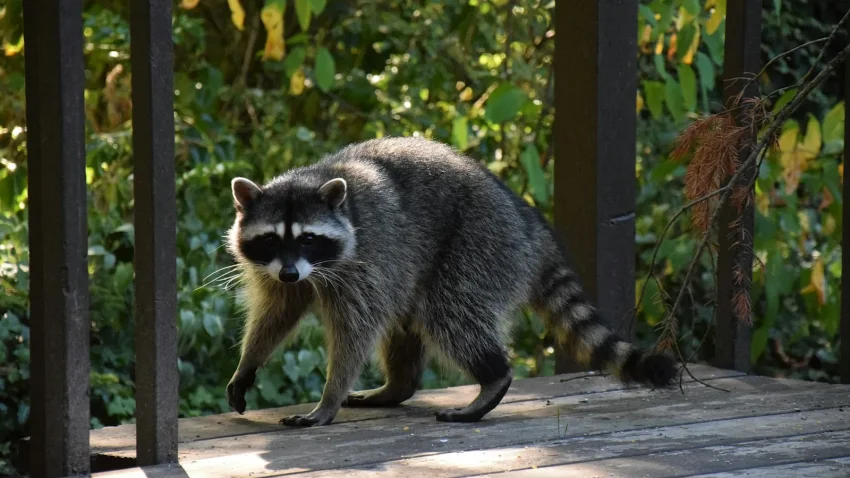
Raccoons lead the state every year, and a raccoon is also the animal most likely to be living in your attic. The two facts are connected but not the same thing: a raccoon in the attic is not evidence that it is rabid, and most are not. What changes when your county has confirmed cases is how you treat contact. Do not handle a raccoon, do not let a dog or cat near one, and treat a raccoon that is out in daylight, staggering, or unafraid of people as a possible case rather than a curiosity. Keep pets' rabies vaccinations current; what happens to a dog or cat after a tangle with a raccoon depends heavily on whether its vaccination was in date. The droppings a raccoon leaves are a separate hazard, covered in why raccoon droppings in an attic are a health risk. Getting the animal out of the structure is a job for a wildlife company, and Florida rules on what can lawfully be done with a trapped raccoon are set out on our raccoon page.
What a rabid bat in your county means for you
Statewide, bats are second to raccoons. In these seven counties they are first: across the four years the table counts 51 confirmed bats against 38 raccoons, and in Orange County in 2025 it was 8 bats to 2 raccoons. The risk with bats is different in kind. The CDC's rabies and bats guidance puts it plainly: bat bites can be tiny, and you may not know you were bitten, so a bat found in a room with someone who was asleep, a child, or anyone who cannot say whether they were bitten is treated as a possible exposure. If that happens, do not release the bat. Contain it without touching it and call your county health department so it can be tested. A colony roosting in an attic is a different situation and is handled by exclusion, never trapping, inside the legal window Florida sets; the rules are in our guide to Florida bat removal laws and the method is on the bat page.
Cats, foxes and the rest
Cats appear in the table more often than dogs, which matches the Department's statewide note that outside cats are the most common domestic animal found with rabies, usually because they are unvaccinated and roam where raccoons do. A stray cat that is acting strangely is not a wildlife-removal call; it belongs to county animal services. Foxes show up in Lake and Brevard in these years, and the footnoted bobcat, dog and otter cases are single animals.
Who to call: animal control or a wildlife removal company?
If a person or a pet has been bitten or scratched, or a bat was found in a room with someone asleep, call your county health department and, for the animal, county animal services. That is a public health matter and it is time-sensitive: post-exposure treatment works when it is started promptly. Our Florida animal control directory by county lists the agency for every county. If the problem is an animal living in your attic, walls, soffit or under the house, and nobody has been exposed, that is what a wildlife removal company does. Dr. Critter removes the animal, seals the entry and cleans up what it left behind, and does not handle bite investigations or testing.
Copy this table
The snippet below reproduces the county totals with the source line attached. You may republish it with that line intact.
Found a raccoon, bat or other animal inside the house and nobody has been bitten? Get a free estimate and we will find how it got in, remove it and seal the entry.
Cite this page
Plain text
Dr. Critter Wildlife Control. "Florida Rabies Cases by County and Species, 2022 to 2025: Central Florida's Numbers From the Department of Health." Published September 15, 2026. https://drcritter.com/blog/florida-rabies-cases-by-county-and-species/
Link
Methodology and reuse
Every figure on this page is read from the Florida Department of Health, Bureau of Epidemiology, "Animal Rabies Confirmed Cases by County and Animal Type" table for the year in question (2022, 2023, 2024 and 2025), linked above the table. Statewide totals are the sum of every county row in the same file. The exposure guidance for bats is the CDC's and is linked where it is used.
The Department's county tables are published from 2022 onward and the 2026 table was not yet posted when this page was compiled, so those are the years shown. Species not broken out (dog, bobcat, otter and similar) are summed under "Other". Nothing is estimated or extrapolated.
Published September 15, 2026. You may republish these figures with attribution and a link to https://drcritter.com/blog/florida-rabies-cases-by-county-and-species/.
Florida Nuisance Wildlife Laws by…


Does Homeowners Insurance Cover…
October 13, 2026
Armadillo Holes in Your Florida…
October 6, 2026


Who to Call for Wildlife in…
September 22, 2026
Florida Rabies Cases by County and…
September 15, 2026


Wildlife Removal Cost in Central…
September 15, 2026
Florida Nuisance Wildlife Trapping…
August 18, 2026


Wildlife Removal vs Pest Control:…
August 11, 2026
Central Florida Wildlife Activity…
August 11, 2026


Rats in Your Attic Could Be More…
August 5, 2026