October 6, 2026
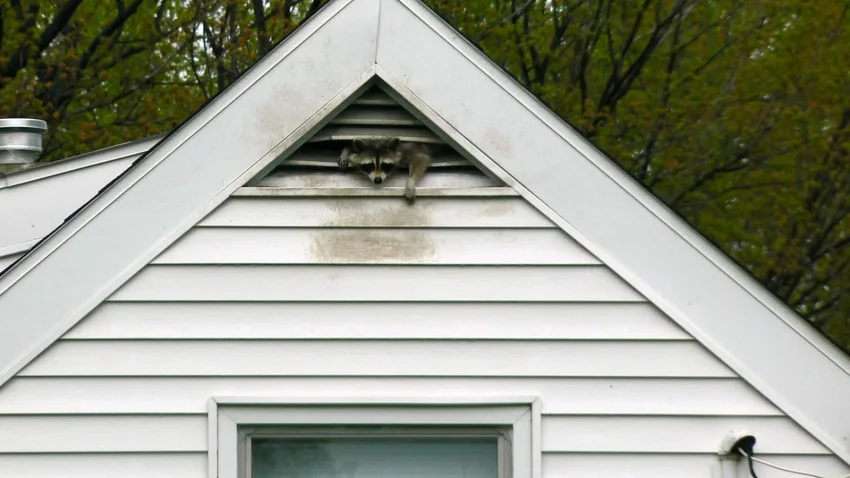
Wildlife Removal vs Pest Control: What Each Actually Handles in Florida
The short answer: a pest control company treats infestations in and around a structure, and Florida law puts insects, wood-destroying organisms, rats, mice, squirrels, bats, and pest birds inside that scope. A wildlife removal company handles the larger nuisance animals that fall outside it, along with the trapping, exclusion, and structural repair that ending an animal problem actually requires. If what you are hearing overhead is a raccoon, an opossum, or an armadillo digging under the slab, that is wildlife work, and no pest control license covers removing it. If it is rats, it sits in the overlap and either trade may be licensed for it. Either way, the thing worth asking on the phone is whether they will seal the entry afterward. Removing an animal and leaving the hole open is what makes a problem come back.
The one-sentence difference
Pest control is licensed to treat a structure. Wildlife removal takes an animal out of it and puts the building back together so the next one cannot follow. The two overlap more than most homeowners expect, and where they overlap the choice comes down to what the job needs rather than what the company is called.
What a pest control company handles in Florida
Structural pest control in Florida is regulated by the Department of Agriculture and Consumer Services under Chapter 482 of the Florida Statutes, and the statute is broader than the word "pest" suggests. It defines a pest as an arthropod, a wood-destroying organism, a rodent, or another undesirable organism, and it defines a rodent as a rat, mouse, squirrel, or flying squirrel, or other animal of the order Rodentia, expressly including a bat. Structural pest control itself is defined to cover insects, vermin, rodents, pest birds, bats, and other pests in, on, or under a structure.
Read plainly, that means a licensed pest control operator in Florida is working inside their category when they deal with roaches, ants, termites, fleas, rats and mice, and in principle squirrels, bats, and pest birds. Their licensing categories are things like general household pest control, termites and other wood-destroying organisms, lawn and ornamental, and fumigation. Good pest control companies are very good at what those categories cover, and none of what follows is a criticism of that work. It is a description of where the boundary sits, and it is the reason a wildlife control visit in Winter Park starts with a roofline inspection rather than a treatment schedule. Rodents are where that boundary gets tested most often, because a rat in a soffit is at the same time a Chapter 482 pest and a structural problem, which is why work like rat control in Auburndale and the rest of the Polk County line is scheduled as wildlife removal with exclusion rather than as a pest treatment.
What a wildlife removal company handles
Nuisance wildlife is the other side of the line, and it is regulated by the Florida Fish and Wildlife Conservation Commission rather than by Chapter 482. In practice that means raccoons, opossums, armadillos, snakes, and the larger animals that get into an attic, a soffit, a chimney, or the space under a deck or a shed. None of those are rodents, and none of them fall inside a structural pest control category. Removing them is wildlife trapping work, which FWC does not license, and in Florida it comes with rules about how a captured animal may be handled that apply no matter who does the job.
The other half of wildlife work is the part that has nothing to do with the animal at all: finding every gap on the building, sealing it so it stays sealed, and repairing what the animal damaged on the way in and while it lived there. That is attic animal removal and exclusion, and it is usually the larger share of both the labor and the invoice. Our humane critter removal page covers how the trapping side is run.
Which of the two you need is also a local question, because the housing stock decides how the job runs. On the Osceola and Polk line, for instance, the newer slab-on-grade subdivisions push the work toward soffit and roof-return gaps rather than crawlspaces, which is why wildlife removal rather than pest control in Poinciana is usually an exclusion job before it is a trapping one.
North of the metro the same distinction shows up as squirrels and roof rats coming in at the gable ends rather than as an insect problem, which is what most Deltona wildlife removal calls turn out to be.
Why rats, squirrels, and bats sit in the overlap
This is where most of the confusion comes from, and the statute is unusually specific about it. Rats and mice are rodents in the ordinary sense and in the statutory sense, and they are also non-native, so no protected-species rule applies to them. Squirrels are rodents too, both in biology and under the Chapter 482 definition. Bats are not rodents biologically, but Florida's pest control statute writes them in as one for licensing purposes.
So for those three species the licensing question genuinely has two answers, and the deciding factor becomes what the job requires rather than which trade is entitled to do it. A rat problem treated as an infestation gets baited or trapped and comes back next season, because the roofline gap that let the first population in is still there. The same problem treated as a structural problem gets the building sealed first and the trapping second, which is the order that ends it. Our roof rat guide and rodent removal page set out what that sequence looks like.
Bats are the clearest case of a species where the license is not the constraint. Whoever you call, the same date applies.
The legal lines that bind whoever you call
Three rules do more to determine what can happen at your house than any licensing category does.
The first is the bat maternity window. Under Florida Administrative Code 68A-9.010, bat exclusion is illegal from April 16 through August 14, because the roost holds pups that cannot fly and sealing the building shuts them in. Every bat species native to Florida is protected. April 15 is the last day a structure can legally be cleared and August 15 the first day work can resume, and the rule binds a pest control operator exactly as it binds a trapper. If anyone offers to remove your bats in June, that is the answer to whether to hire them. The Central Florida bat guide covers how the exclusion is actually done.
The second is the general prohibition in Florida Administrative Code 68A-4.001: no wildlife, nor their nests, eggs, young, homes, or dens, may be taken, transported, bought, sold, or possessed except as Title 68A specifically permits. That is what makes killing the harmless black racer in the garage the wrong move rather than a free one.
The third governs what happens after capture. Under 68A-9.010, a live-captured nuisance animal must be released on the property where it was caught, released off site only where that land lies in the same county, runs to at least 40 contiguous acres and its owner has given written permission, or euthanized humanely, and within 24 hours of the capture or of the trap being checked. Relocating it to a park across the county is not one of the options. Raccoons are also a rabies vector species in Florida, which is a further reason relocation is not permitted. Anyone offering to drive your raccoon out to the woods is describing something the state does not allow.
Why removal without exclusion and repair fails
An animal in an attic is a symptom. The opening it used is the condition. Remove the animal and leave the opening and the space is re-occupied, often within the same season and frequently by a different species, because a hole that admitted a squirrel will admit a rat and a hole that admitted a raccoon will admit almost anything.
The damage compounds while that runs. Insulation gets flattened into nesting beds and loses its R-value. Droppings and urine contaminate it, which turns a cleanup into an insulation replacement. Rodents gnaw wire sheathing and water line. Raccoon feces can carry Baylisascaris procyonis, a roundworm whose eggs survive in the environment for years and are not killed by ordinary disinfectants, so a contaminated attic becomes a removal job rather than a wipe-down. Armadillo burrows undermine the fill beneath slabs and pool decks. None of that is fixed by anything applied from a sprayer, which is the honest reason the structural side of the work matters as much as the animal side.
How to tell from the noise what you have
The time of day narrows it faster than anything else. Squirrels run in daylight, heaviest around sunrise and again before dusk, and the sound is quick and light. Roof rats run after dark, with the first few hours after sunset and the hour before dawn the busiest, and they travel along the edges of the attic rather than across it. Raccoons are heavy and slow, you hear weight shifting rather than scampering, and a female with young adds chittering that carries through the ceiling. Opossums are heavy too but clumsier and quieter, with a dragging quality and no vocal calls. Bats make no footsteps at all: what you hear is a high chittering at the roost that builds in the half hour before they emerge at dusk.
If you want to work through it properly, our attic noise identification guide goes species by species, and the scratching in the attic post covers what the different sounds mean for the job and for the law.
So which one do you call?
Call pest control for insects, for termites, and for a straightforward rat or mouse problem where the building is sound. Call a wildlife company when the animal is bigger than a rodent, when the noise is overhead rather than in the walls, when anything is digging under a structure, when bats or a protected species are involved, or when the same problem has already been treated once and come back. That last one is the most reliable signal there is, because a problem that returns is almost always a sealing problem rather than a treatment problem.
Dr. Critter has worked Central Florida wildlife since 1996, across Orlando and the surrounding metro, registered with FWC as a nuisance wildlife control operator. If you are not sure which side of the line your problem falls on, describing the noise and the time of day over the phone is usually enough for us to tell you, including when the answer is that you want an exterminator instead.
Armadillo Holes in Your Florida…


Who to Call for Wildlife in…
September 22, 2026
Florida Rabies Cases by County and…
September 15, 2026


Wildlife Removal Cost in Central…
September 15, 2026
Florida Nuisance Wildlife Trapping…
August 18, 2026


Wildlife Removal vs Pest Control:…
August 11, 2026
Central Florida Wildlife Activity…
August 11, 2026


Rats in Your Attic Could Be More…
August 5, 2026
Does Homeowners Insurance Cover…
July 21, 2026


Bat Removal in Central Florida:…
July 9, 2026