Click here for a free estimate to remove Rats!
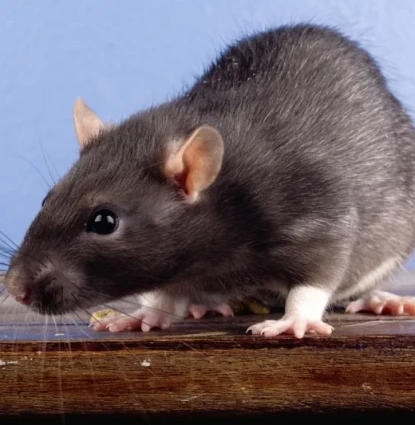
Rats
Florida has two primary commensal rat species: the Roof Rat (Rattus rattus), which dominates urban Central Florida and prefers attics and palm trees, and the Norway Rat (Rattus norvegicus), which is more common at ground level near dumpsters and crawl spaces. Rats can squeeze through gaps as small as 1/2 inch and chew through aluminum flashing, wood, and PVC. They reach reproductive maturity at 5 weeks and produce 5-12 pups every 21 days, which is why infestations escalate quickly. Florida law allows rat control on private property, but rodenticides are restricted to certified applicators near schools and water bodies. Professional exclusion combines population reduction with permanent sealing of every entry point; bait-only approaches without exclusion only delay re-infestation.
If you're hearing nocturnal noises, scratching within your walls, or rustling sounds in your attic, you likely have a rat infestation. Rats leave behind numerous small droppings and create extensive tunnels through insulation, resembling Swiss cheese. You may also find droppings in your basement, kitchen, or bedroom. These signs warrant immediate attention. The longer rats remain in your home or office, the greater the potential for damage. Rats are known to chew through pipes, wood, and wires, posing risks of floods and fires.
If you suspect a rat or rodent problem, don't delay. Dr. Critter offers specialized programs to address rat infestations of any size. Contact us today to prevent further damage and restore peace of mind.
What does a roof rat do to a Central Florida attic?
It chews, and it chews the things that matter. Roof rats gnaw wire sheathing, irrigation and PVC line, and the paper facing on insulation, which is how a rodent problem becomes an electrical or a water one. They cut runs through blown-in insulation until the attic floor looks channeled, and they leave droppings along those routes rather than in one repeated spot the way a raccoon does. The droppings are small, dark, and pointed at both ends, and you find hundreds of them rather than a dozen.
What does a rat in the attic sound like?
Light, fast, and scratchy, and it usually stops for a moment when you knock on the ceiling. Squirrels run in daylight. Roof rats run after dark, heaviest in the first few hours past sunset and again before dawn. The sound tracks along the top plate where the wall meets the roofline rather than crossing the open attic, because rats travel edges. A slow filing noise from inside a wall is usually a rat working on a stud or a cable rather than anything structural settling.
Where do roof rats get in, and why is it always the roofline?
Because a roof rat climbs, so it enters high rather than low. According to University of Florida IFAS Extension, roof rats nest above ground by preference: in attics and soffits, in hollow trees, and in the skirt of dead fronds left on an untrimmed palm. That last one is the detail most homeowners here miss, because a palm growing against the house is a ladder with a nest already in it. The entries we find most often are the gap where a soffit return meets the roof deck, a lifted tile or shingle edge, an unscreened gable or ridge vent, and the plumbing and cable penetrations through the roof.
How fast does a rat problem grow if it is left alone?
Fast enough that waiting a month is a decision with a cost. UF/IFAS puts a roof rat litter at five to eight pups after a gestation of only 21 to 23 days, and a female at four or five litters in a year. That arithmetic is how one unsealed roofline gap turns into a resident population inside a single season, and it is also why trapping without sealing never finishes the job: the building keeps admitting replacements faster than the traps remove residents.
| Season | What the animal is doing | Typical attic sign |
|---|---|---|
| Oct–Dec | Moving indoors as nights cool; peak call volume | New scratching overhead, fresh droppings along wall tops |
| Jan–Mar | Resident population breeding in the attic | Squeaking from wall voids, widened insulation runs |
| Apr–Jun | Young dispersing; yard and citrus activity rises | Gnawed roofline gaps reopened, damage to soffit edges |
| Jul–Sep | Outdoor foraging peaks in the wet season | Palm and tree nesting, droppings on flat roofs and gutters |
Are rats protected in Florida?
No. The roof rat and the Norway rat are both introduced species rather than native wildlife, so the FWC disposition rules that govern raccoons, opossums, and armadillos do not apply to them. There is no closed season and no restriction on how a captured rat is handled. Rats are the one species on this site where the legal question is straightforward and the structural question is the whole job.
Why does a rat problem often bring a snake with it?
Because rats are what the snake came for. A yard or attic carrying a rat population is a food supply, and snakes follow it in. Clearing the rats regularly ends the snake calls a few weeks later without anyone touching a snake, which is why finding both at once is usually one problem rather than two. Our Florida snake removal page covers which species turn up around homes here and what state law allows you to do about them.
How long does rat control take?
Two to six weeks in most homes, and the sealing sets the length rather than the trapping. The inspection maps every roofline gap and roof penetration on the structure, and those close first, because trapping an open building means trapping the whole street indefinitely. Trapping then runs one to three weeks until activity stops. Contaminated insulation and droppings come out once the structure is sealed and the attic has gone quiet.
Rats are the most common attic call in the metro, so rat control in Orange County covers the local timing and the roof types that fail first.
Dr. Critter has worked as a nuisance wildlife control operator in Central Florida since 1996 and is listed with the Florida Fish and Wildlife Conservation Commission operator directory. Worth knowing, because most of this industry says otherwise: the FWC does not issue a trapper license, and no state license is required to remove nuisance wildlife from your home. What actually governs the work is rule, not paperwork. FWC rule 68A-9.010 decides what happens to an animal once it is caught alive: release on the property where it was trapped, release somewhere else only when that land is in the same county, is 40 contiguous acres or more, and its owner has put the permission in writing, or humane euthanasia. Dropping it off anywhere short of that is not on the list, whatever the operator tells you, and that rule binds every operator in Florida whether or not they are on any directory.