Click here for a free estimate to remove Snakes!
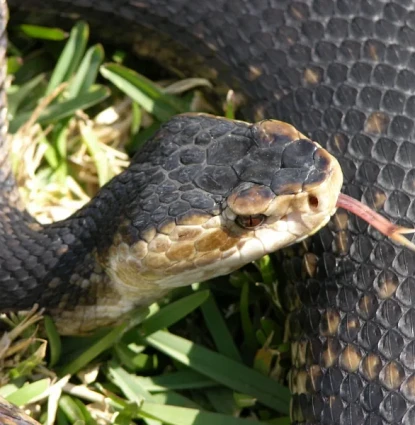
Snakes
Florida is home to 50+ native snake species, of which six are venomous: the Eastern Diamondback Rattlesnake, Timber Rattlesnake, Dusky Pygmy Rattlesnake, Cottonmouth (Water Moccasin), Copperhead, and Eastern Coral Snake. The Eastern Diamondback delivers the most clinically severe bite of any Florida snake and any suspected envenomation requires an ER visit within hours for antivenom. Non-venomous Florida snakes (corn snakes, black racers, garter snakes, rat snakes) are protected by Florida statute and play a useful role suppressing rodent populations. Florida law prohibits killing a snake unless it presents an immediate threat. Professional removal under FWC guidelines uses snake tongs and species-specific containers, with safe relocation off-property. Always identify the snake from a safe distance before approaching; identification photos from across a room are enough.
Snakes often evoke fear and anxiety, even though the majority we encounter are non-venomous. However, caution is always necessary, as encounters with venomous snakes do occur. The most obvious sign of a snake problem is a visual sighting. Shed snake skin can also be an indicator. Notably, certain snake species are attracted to homes with rodent problems, often entering attics or crawlspaces in pursuit of prey.
If you encounter a snake in or around your home, don't hesitate to call us. We can attempt to identify the snake over the phone, helping to determine if it poses a venomous threat. To further assist you, we've created a free resource: the Dr. Critter Venomous Snake Guide of Florida, available for download.
Which snakes actually turn up around a Central Florida home?
Mostly harmless ones. According to University of Florida IFAS Extension, Florida holds roughly 50 native snake species and only six of them are venomous, and just four of those six occur in central and southern Florida: the eastern diamondback rattlesnake, the pygmy rattlesnake, the cottonmouth, and the harlequin coral snake. The copperhead and the timber rattlesnake are north Florida animals and are not part of the picture here. What we are usually called out for is a black racer, a yellow rat snake, or a garter snake beside a pool deck, none of which are venomous and all of which are protected.
Is it legal to kill a snake in Florida?
Usually not, and this catches people out. Florida Administrative Code 68A-4.001 is a general prohibition: no wildlife, nor their nests, eggs, young, homes, or dens may be taken, transported, bought, sold, or possessed except as Title 68A specifically permits. Native nonvenomous snakes fall under it, so killing the racer in the garage is not the free action most homeowners assume it is. It is also the least effective response available, because the snake was there for a reason and removing one does nothing about the reason.
| Species | Where it is usually encountered | How often we see it on a call |
|---|---|---|
| Pygmy rattlesnake | Palmetto scrub, mulch beds, lawn edges | The venomous species we are called to most |
| Eastern diamondback | Dry scrub and pine flatwoods, rural lots | Uncommon in developed neighborhoods |
| Cottonmouth | Lake, pond, and canal edges | Waterfront properties, often misidentified |
| Harlequin coral snake | Leaf litter, under debris and boards | Rare, secretive, seldom seen above ground |
How do you tell a venomous snake from a harmless one?
Not by head shape, which is the rule of thumb that gets harmless snakes killed. A frightened water snake flattens its head into a triangle and passes for a cottonmouth easily. Identification is by pattern and species, and UF/IFAS publishes a residential identification guide for exactly this reason. The coral snake is its own case, because it is banded rather than blotched and the bands that matter are red against yellow. If you cannot make the call with certainty from a distance, treat it as venomous, leave it alone, and have someone identify it who does this for a living.
Why is there a snake near the house at all?
Because something it eats is living there. Snakes follow rodents, and a property with roof rats in the attic or under the shed is advertising a food supply. The second draw is cover: dense ground plantings against the foundation, stacked lumber, uncleaned mulch beds, and gaps under sheds and decks all give a snake somewhere to be. Repellents scattered around the yard don’t change either one, and the evidence on whether snake repellents actually work is thin: any effect wears off and the snake comes back. Fixing those two things does more than removing any individual animal, and our rat control page covers the half of it that most snake calls trace back to.
What should you do when you find a snake indoors?
Keep it in sight from a safe distance and close the interior doors so it stays in one room. Do not try to catch it, and do not try to kill it, which is where most snakebites in Florida actually happen. If it is in a garage or a lanai with an exterior door, opening that door and leaving the room is often enough for the animal to let itself out. Pets and children go somewhere else until it is dealt with. Inside the metro that call is usually a same-day one; snake control in Orlando covers how the visit runs and what we do with the animal afterwards.
How long does snake removal take?
A single visible snake is usually one visit and under an hour. Repeat sightings are the longer job, because the work is exclusion and habitat rather than capture: sealing the gaps under the slab edge, the garage door seal, the shed skirt and the utility penetrations, then cutting back the cover and dealing with whatever rodent population is feeding them. That runs one to two weeks and it is the part that stops the calls coming back. How a visit runs from the first call, and what it covers, is on our page for snake removal in Central Florida.
Dr. Critter has worked as a nuisance wildlife control operator in Central Florida since 1996 and is listed with the Florida Fish and Wildlife Conservation Commission operator directory. Worth knowing, because most of this industry says otherwise: the FWC does not issue a trapper license, and no state license is required to remove nuisance wildlife from your home. What actually governs the work is rule, not paperwork. FWC rule 68A-9.010 decides what happens to an animal once it is caught alive: release on the property where it was trapped, release somewhere else only when that land is in the same county, is 40 contiguous acres or more, and its owner has put the permission in writing, or humane euthanasia. Dropping it off anywhere short of that is not on the list, whatever the operator tells you, and that rule binds every operator in Florida whether or not they are on any directory.