October 20, 2026
Armadillo Holes in Your Florida Yard: How to Tell, What They Mean, and What to Do
You walk out in the morning and the lawn looks like someone went over it with an apple corer. Dozens of small, cone-shaped holes, chunks of sod flipped over, a flower bed half dug out. In Central Florida, the most likely culprit is the nine-banded armadillo. But squirrels, skunks, raccoons and moles also dig in yards, and the fix for each one is different. This guide covers how to read armadillo holes in a Florida yard, how to tell them apart from other digging, and when a hole by your slab is a bigger problem than torn-up grass.
What do armadillo holes look like?
Armadillos leave two very different kinds of holes, and it helps to know which one you're looking at.
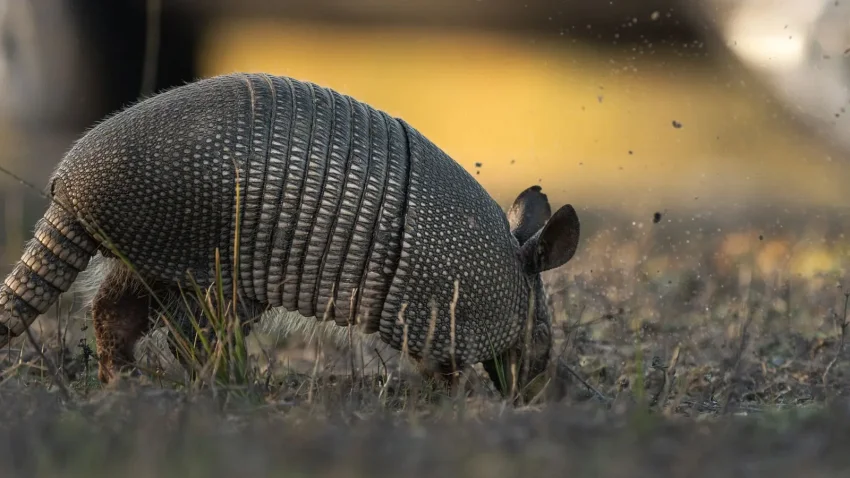
Feeding holes are the ones that show up by the dozen overnight. An armadillo walks along with its nose to the ground, smells an insect or earthworm in the soil, and digs a quick probe to get it. According to the UF/IFAS Extension fact sheet on the nine-banded armadillo, these feeding holes are typically 1 to 3 inches deep and 3 to 5 inches wide. A separate UF/IFAS Gardening Solutions guide, Who Made That Hole?, describes armadillo foraging holes as narrower and deeper, 1 to 2 inches wide and up to 6 inches deep. Treat those numbers as a range, not a rule.
What gives armadillo feeding away is the pattern more than any single hole. The UF/IFAS Extension Sarasota County fact sheet on wildlife yard holes describes it as several shallow feeding disturbances of rooted or turned soil and grass, close together. In practice that looks like a trail of small pits and loose plugs of sod, often worst along bed edges, under shrubs and in the dampest part of the lawn.
A burrow entrance is a different thing entirely. It's where the armadillo sleeps. UF/IFAS puts armadillo burrows at about 7 to 8 inches in diameter and up to 15 feet long, usually under brush piles, stumps, rock piles, dense brush or concrete patios. The Sarasota fact sheet adds that burrows tend to sit close to structures, fencing or roots and that the opening is round and roughly body-shaped. FWC's armadillo species profile notes that a single armadillo can have several burrows with multiple entrances.
Around homes, that preference for cover means we look first at the edges of hard surfaces: patio and porch slabs, walkways, driveways, AC pads, porch steps, and anywhere a woodpile or brush pile sits against the ground. A fresh entrance usually has a fan of loose sand thrown out in front of it.
Armadillo holes vs. other animal digging
Several Florida animals dig for the same food. The table below sums up how the damage usually differs. Tracks, droppings and timing help too: most of the diggers below feed at night, so the damage tends to appear by morning.
| Animal | What the damage looks like | Main clue |
|---|---|---|
| Armadillo | Many small cone-shaped probes close together, uprooted plants and turned sod; separate round burrow entrances about 7 to 8 inches wide near slabs, roots or brush | Lots of small pits in a feeding trail, plus a body-sized hole near cover |
| Gray squirrel | Small, shallow holes, often near trees | Few holes, very shallow, usually a buried or dug-up nut or seed |
| Skunk | Holes made by pushing the nose into the lawn and digging out with the front paws; heavy feeding can merge into one torn-up patch | Small, scattered nose pokes rather than a long trail of probes |
| Raccoon | Sod lifted and flipped over in pieces, sometimes rolled back like someone meant to replant it | Whole sections of turf peeled back, not pits |
| Eastern mole | Raised ridges of soil just under the surface and small cone-shaped mounds | Tunnels you can feel underfoot, no open holes |
| Birds | Shallow pecking and pulled thatch in grub-infested turf | Surface damage only, usually seen in daylight |
| Gopher tortoise | One burrow with a domed top and flat bottom shaped like the shell, with a sand apron at the entrance | Half-moon opening; this is a protected species, so leave it alone |
Sources for the table: the UF/IFAS armadillo fact sheet, Who Made That Hole?, the Sarasota County yard holes fact sheet, UF/IFAS Extension's publication on moles, and Iowa State University Extension's page on skunk and raccoon damage to lawns. The bird row is a general description from our own field work rather than a published measurement.
That gopher tortoise row matters. The Sarasota fact sheet notes that the tortoise is a threatened, protected species and that land within 25 feet of a burrow must be left undisturbed. If the hole is shaped like a half moon, flat on the bottom, don't fill it, block it or set anything near it.
Does a hole by the slab mean a burrow under the house?
Often, yes. A feeding probe is a dead end a few inches deep. A burrow entrance is wide enough for the whole animal and runs back at an angle, and if it starts at the edge of a patio, walkway, porch or AC pad, the tunnel is almost certainly heading underneath it.
The UF/IFAS fact sheet states plainly that armadillo burrows under driveways and patios can cause structural damage. The reason is simple: every inch of tunnel is sand that used to hold the slab up and now sits in a pile on your lawn. Florida's sandy soil moves easily, and rain running into an open burrow can wash out more. Over time you can end up with a hollow under the edge of a walkway or pad. Warning signs include a slab edge that sounds hollow when tapped, new cracks, a pad that has started to tilt, or sand piling up at one corner after every rain.
A few practical signs that a burrow is active:
- Fresh, loose sand at the entrance, especially after rain has smoothed everything else
- New feeding holes appearing in the lawn nearby each morning
- Spider webs or leaves across the opening getting disturbed overnight
Don't stuff an active burrow with dirt or block it with a paver. FWC's guidance on encouraging an armadillo to leave a burrow specifically says to do it without blocking the animal from exiting.
Why are armadillos digging in my yard?
Food. Armadillos eat insects, larvae, earthworms and other invertebrates, plus some fruit and plant matter. UF/IFAS lists armyworms, cockroaches, ants, beetles and grasshoppers among their foods, and says it plainly: a moist, lush landscape is perfect for earthworms and insect larvae, and armadillos love earthworms.
That's why the best-kept lawn on the street is often the one that gets hit. Irrigation and fertilizer grow the grubs and worms that armadillos are hunting for. Mississippi State University Extension notes that digging by skunks, raccoons, armadillos and moles is often a telltale sign of grubs in the turf. So if the digging keeps coming back to the same areas, it's worth checking for a grub problem as well as an animal one.
FWC also points out that armadillos are drawn to fermenting fruit, so citrus or mango drops left on the ground add to the menu. And because armadillos rest in burrows during the day and feed in the late evening, night or early morning (according to UF/IFAS), you rarely see the animal itself. You just find the results.
What does Florida law allow for armadillos?
FWC describes the armadillo as a mammal native to southwestern North America that expanded its range into Florida and is now considered naturalized here, and it says it is lawful for a landowner to live-trap or humanely destroy nuisance armadillos, with specific rules on where a captured animal may be released. We cover trapping, relocation and the rest of the legal detail in our post on armadillo trapping laws and yard damage in Central Florida.
How to keep armadillos out, and when to call
Start by making the yard less of a buffet. FWC recommends keeping watering and fertilization to a minimum and watering gardens in the morning, so the soil dries out by afternoon and gives a nocturnal armadillo less to go on. Pick up fallen fruit. If grubs are part of the problem, deal with them too, or the next digger will show up for the same meal.
Fence the areas that matter. Both FWC and UF/IFAS say fencing works for small areas with heavy damage, as long as it goes underground. FWC's minimum is fencing at least 2 feet high with an apron buried at least 18 inches deep. The UF/IFAS fact sheet gives similar numbers, about 24 inches above ground and 18 inches below, with the fence slanted outward at roughly a 40 degree angle. A fence that just sits on the surface won't do much against an animal built to dig.
Seal burrow sites only after they're empty. Once the armadillo is gone, the burrow under a slab or pad needs to be filled and the edge protected so the next one can't start in the same place. That usually means backfilling the tunnel and installing a buried barrier along the edge of the slab, porch or pad. Our animal and wildlife proofing work covers that kind of exclusion.
Skip the gimmicks. The UF/IFAS fact sheet states that poison baits are illegal and ineffective, and that no chemical repellents or fumigants are registered for armadillo use in Florida. FWC adds that armadillos are hard to catch in live traps, which matches our experience.
It's time to call for armadillo removal when:
- You've found a burrow entrance at the edge of a slab, patio, walkway, AC pad or porch
- The digging keeps coming back night after night, even after you cut back watering
- A slab or pad sounds hollow, has new cracks or has started to tilt
- You aren't sure the hole belongs to an armadillo and not a gopher tortoise
Dr. Critter is a family-owned wildlife company working across Greater Orlando and the Tampa area. If you're in the Orlando area, see our armadillo control in Orlando page; for Lakeland, Winter Haven and the rest of Polk, see armadillo control in Polk County.
Armadillo holes FAQ
How big are armadillo holes?
Feeding holes are small. UF/IFAS Extension describes them as about 1 to 3 inches deep and 3 to 5 inches wide, while a UF/IFAS gardening guide describes narrower probes up to 6 inches deep. Burrow entrances are much bigger, about 7 to 8 inches across, and the tunnel can run up to 15 feet.
Do armadillos dig under houses and slabs?
Yes. UF/IFAS lists concrete patios among their usual burrow sites and says burrows under driveways and patios can cause structural damage. Around homes, check the edges of slabs, walkways, porches and AC pads for round holes with loose sand in front.
Should I fill in an armadillo hole?
Feeding holes, yes; press the sod back in. Don't fill a burrow until you're sure it's empty, because FWC's advice is to encourage the animal out without blocking its exit. Once it's empty, fill it and protect the edge with a buried barrier so another armadillo doesn't reuse it.
Will cutting back on watering stop armadillo digging?
It helps. FWC and UF/IFAS both recommend keeping watering and fertilizing to a minimum, since a moist, lush lawn grows the earthworms and larvae armadillos eat. It won't move an armadillo that already has a burrow under your patio, though.
Are armadillos dangerous to handle?
FWC lists leprosy, St. Louis encephalitis, leptospires and arboviruses among the diseases armadillos can carry. Don't handle one with bare hands, and wear gloves if you're cleaning up around a burrow.
Photo by Dmytro Koplyk on Pexels
If you're seeing fresh holes every morning or a burrow by your slab, request a free quote or call 800-932-7287. We'll identify what's digging, check whether anything is under your concrete, and set up removal and exclusion that keeps the next armadillo out.
Sources: this guide cites University of Florida IFAS Extension (the armadillo fact sheet, the publication on moles, the Who Made That Hole? guide and the Sarasota County yard holes fact sheet), the FWC armadillo species profile, Iowa State University Extension and Mississippi State University Extension, each linked where it is used. You may republish this guide's information with attribution and a link to https://drcritter.com/blog/armadillo-holes-in-florida-yards/.
Quoting this guide? Cite this page ShowHide
Dr. Critter Wildlife Control. "Armadillo Holes in Your Florida Yard: How to Tell, What They Mean, and What to Do." Published October 6, 2026. https://drcritter.com/blog/armadillo-holes-in-florida-yards/
Link:
Florida Nuisance Wildlife Laws by…


Does Homeowners Insurance Cover…
October 13, 2026
Armadillo Holes in Your Florida…
October 6, 2026


Who to Call for Wildlife in…
September 22, 2026
Florida Rabies Cases by County and…
September 15, 2026


Wildlife Removal Cost in Central…
September 15, 2026
Florida Nuisance Wildlife Trapping…
August 18, 2026


Wildlife Removal vs Pest Control:…
August 11, 2026
Central Florida Wildlife Activity…
August 11, 2026


Rats in Your Attic Could Be More…
August 5, 2026