October 13, 2026
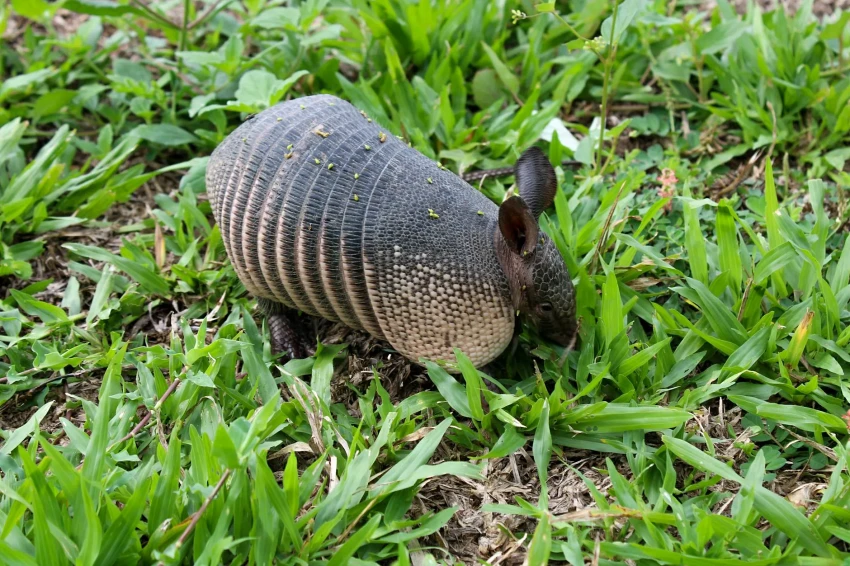
Armadillo Removal in Central Florida: Trapping, Laws, and Yard Damage
If you've stepped onto your lawn and found it looking like a backhoe rolled through overnight, you almost certainly have an armadillo. The nine-banded armadillo (Dasypus novemcinctus) is a uniquely destructive Central Florida yard pest — not because it's aggressive, but because the way it forages turns turf, mulch beds, and flower borders into a minefield of conical holes in a single night.
Here's what Florida homeowners need to know about armadillo damage, what Florida law says about removing them, and how Dr. Critter handles armadillo problems differently from your average pest call.
How to Tell an Armadillo Is the One Wrecking Your Yard
Armadillo damage is distinctive enough that you usually don't need a wildlife camera to confirm. Look for:
- Conical holes 3–5 inches across and 3–8 inches deep, scattered across the lawn, mulch beds, or under shrubs. The holes are vertical with sharp edges — not the angled trenches a dog digs and not the surface tunnels of moles.
- Uprooted plants and mulch shoved aside. Armadillos eat earthworms, beetle grubs, and ant pupae; they push aside everything else looking for them.
- Burrow entrances 6–10 inches wide in shrub lines, under decks, against concrete pads (AC, pool equipment), or in dense plantings. A single armadillo will dig several burrows across its range.
- Heavy damage after rain. Wet soil is easier to dig and brings invertebrates closer to the surface. Most homeowners notice armadillo activity after a thunderstorm.
- No tracks or droppings on hard surfaces. Armadillos avoid pavement when they can. If the damage stops at the driveway and resumes on the other side, that's consistent.
Most homeowners notice the damage the morning after — armadillos are nocturnal in Florida summers, doing most of their foraging between dusk and 3 a.m.
Why Armadillos Have Become a Florida-Specific Problem
Armadillos are not native to North America. The nine-banded armadillo expanded out of Mexico in the late 1800s and reached Florida by the early 1920s, partly under its own dispersal and partly through human introduction. Their range now covers the entire state, and Florida's combination of soft, moist soil, abundant grubs and earthworms, mild winters, and protected suburban habitat is essentially the perfect armadillo environment.
According to the University of Florida IFAS Wildlife Extension, a nine-banded armadillo digs and maintains an average of ten burrows within its home range, and a single burrow can run up to 20 feet long and 7 feet deep. Those tunnels frequently undermine foundations, driveways, AC pads, and pool decks, which is why armadillo damage often costs more than the torn-up turf suggests.
A few traits make them harder to deter than most yard pests:
- They're solitary and territorial. Removing one armadillo from a property doesn't guarantee another won't move in, but the next one usually takes weeks to months to establish — not the overnight replacement you see with rats.
- They almost always produce four identical pups per litter. Armadillos give birth to four genetic clones — a single fertilized egg always splits into quadruplets. A breeding female on your property next door means four more juveniles dispersing within 8 months.
- Their armor protects them from most predators in suburban environments. Coyotes and large dogs can take adult armadillos, but the average backyard predator profile (foxes, raccoons) doesn't include them.
- They cannot be deterred chemically. No bait, repellent, or treatment marketed for armadillos works reliably. The University of Florida IFAS extension service is direct about this in their armadillo management publication: physical trapping and exclusion are the only methods with documented success rates.
Are armadillos protected in Florida?
No. The Florida Fish and Wildlife Conservation Commission (FWC) species profile classifies the nine-banded armadillo as a non-native, non-protected species, so it can be legally trapped and removed on your own property year-round without a special permit. There is no closed season and no bag limit. The rules that do apply concern trapping method and relocation, not protection:
- Live trapping on your own property is legal without a special permit. You may use a humane cage trap and remove the animal.
- Relocation is restricted.FWC rule 68A-9.010 allows an off-site release only where the site is a minimum of 40 contiguous acres, is in the same county as the capture site, and you hold the landowner’s written permission, so releasing one in a patch of woods behind a subdivision is not lawful. Most relocated armadillos either die en route or fail to establish in unfamiliar territory anyway, so relocation isn't humane in practice.
- Lethal methods must be humane.FWC rule 68A-9.010 requires euthanasia by a method the AVMA Guidelines for the Euthanasia of Animals accept as humane. Poisoning, drowning and live-burying are all outside that.
- Discharging a firearm is regulated by local ordinance even when state law would allow it. In most Central Florida residential neighborhoods, this is not a legal option for armadillo removal.
- There is no state trapper licence to hold. The FWC states plainly that it does not license nuisance wildlife trappers; what exists is a voluntary directory, and Dr. Critter is listed on it. What binds the work is the rule above, not a licence, which is why the method and the disposition are the parts to get right.
Can you kill armadillos in Florida?
Yes, and legally so. FWC rule 68A-9.010 lets a landowner live-trap or humanely destroy an armadillo that is damaging property, with no permit, no closed season and no bag limit. What the rule constrains is what happens next: a live-caught animal must be released on the capture property, released off site only where that land lies in the same county, runs to at least 40 contiguous acres and its owner has given written permission, or euthanized by a method the American Veterinary Medical Association accepts as humane. Whichever it is, the rule allows 24 hours from the capture or from the trap being checked. Poisoning, drowning and burying alive are all illegal.
Whether you should is a different question, and our answer is usually no. Killing the armadillo in your yard does nothing about the yard, and a lot that is watered, grub-rich and easy to dig under simply attracts the next one within a season. We trap the animal that is already there, then change what made the property worth digging: irrigation, grub load, and a buried barrier at the foundations, deck and AC pad. That is the part that holds.
Florida has just one armadillo species, the nine-banded armadillo, which the Florida Fish and Wildlife Conservation Commission lists as non-native and unprotected. Because it carries no legal protection, FWC rules let a property owner live-trap or humanely remove nuisance armadillos on private land at any time of year, without applying for a special permit.
The FWC's armadillo species profile is the authoritative reference for current regulations.
The Trapping Process That Actually Works
Most homeowners who try to trap an armadillo themselves give up after a few empty mornings. The reason is almost always trap placement, not the trap. Armadillos don't respond to bait the way raccoons or rats do — they smell and dig for prey rather than approaching food set out for them. The reliable approach is exclusion-funnel trapping:
- Identify the active travel route. Armadillos use the same paths repeatedly. Look for matted vegetation, repeated dig clusters, or a worn line between two areas of fresh damage.
- Place the trap directly in the travel path, not next to it. A live-cage trap (32×10×12 inch minimum) set lengthwise in the path catches the animal as it walks through. Baited traps not in the path almost never produce a catch.
- Build wing walls. Place 6-foot lengths of 1��6 lumber or temporary plastic landscape edging in a "V" extending out from the trap entrance to funnel the animal toward the opening. This is the single biggest factor in trap success rates.
- Set after sunset, check before dawn. Daytime traps are wasted; armadillos are not active. Pre-dawn check minimizes the time a captured animal spends stressed.
- Dispatch or transport per Florida law. See legal section above. Dr. Critter handles this step for clients.
For multi-armadillo properties (especially where a litter of four juveniles has dispersed), the process repeats per animal. Plan on 2–6 nights of trapping for a single problem armadillo, and 2–3 weeks for a property with an active breeding adult plus offspring.
Prefer to skip the 2–6 nights of pre-dawn trap checks? Our humane armadillo removal service handles the trap-and-relocate work for you from first inspection to final exclusion. Our species page covers what armadillo removal actually involves step by step, including the FWC disposition rules that decide where a trapped animal can go.
Why DIY Repellents and Home Remedies Don't Work
The internet has a substantial body of advice on "natural armadillo deterrents" — castor oil, mothballs, predator urine, ammonia-soaked rags, motion-activated sprinklers, ultrasonic devices. The University of Florida IFAS extension and the National Wildlife Control Operators Association both report that none of these produce documented, reliable results. The reason is that armadillos are driven by prey scent (worms and grubs in the soil), not by aversion to surface smells. Their poor eyesight and high tolerance for human-adjacent disturbance make most sensory deterrents ineffective.
The two methods that do work are physical — trap-and-remove the animal, and structural exclusion to prevent re-entry to specific areas. Neither requires repellent products.
Permanent Exclusion: Keeping Armadillos Out for Good
Once a property's resident armadillo is removed, the next question is preventing the next one from moving in. Exclusion options ranked by effectiveness for Central Florida properties:
- Buried wire fencing around vulnerable areas — flower beds, foundation lines, under decks. The fence should be 24 inches above grade and 12–18 inches below grade, angled outward at the bottom. 1×1 or 2×2 inch galvanized wire mesh works; chicken wire is too soft and gets pushed aside.
- Under-deck and crawl-space sealing. Armadillos love sheltered burrow spots. Skirting under decks, sealing crawl-space lattice with mesh, and blocking gaps around AC pads and pool equipment eliminates the high-value den sites.
- Lawn integrated pest management. Reducing grub populations (the armadillo's primary food) reduces the property's attractiveness. Beneficial nematodes, biological grub treatments, and well-timed lawn aeration all help — your lawn care company handles this side; Dr. Critter handles the armadillo side.
- Removing brush, woodpiles, and dense ground cover within 18 inches of the foundation. Eliminates intermediate cover that lets armadillos approach the house without being detected by yard dogs or motion lights.
For full-property exclusion in heavily armadillo-active areas, Dr. Critter's wildlife proofing program bundles inspection, trap-and-remove, and structural exclusion into a single quoted job.
Health Concerns: Armadillos and Hansen's Disease
One health note worth mentioning briefly because it surprises homeowners: nine-banded armadillos are one of the few wild mammals naturally susceptible to Mycobacterium leprae, the bacterium that causes Hansen's disease (leprosy). The CDC has documented zoonotic transmission from armadillos to humans in the southeastern United States, including Florida. The risk is genuine but low and is associated specifically with direct handling, butchering, or consuming armadillo meat. Casual yard contact does not transmit the disease.
The concern is regionally specific. In the CDC's Emerging Infectious Diseases journal, researchers reported that Central Florida accounts for roughly 81 percent of the leprosy cases reported in the state and nearly one-fifth of all U.S. cases, and that the same M. leprae strains carried by wild armadillos have turned up in local human patients.
The practical implication for homeowners: don't handle a live or dead armadillo with bare hands. Use gloves, wash thoroughly afterward, and let an experienced operator handle removal. The CDC's Hansen's disease transmission page covers the science in detail.
Frequently Asked Questions
How much damage can one armadillo do in a night?
A single armadillo can leave 30–60 conical holes across a half-acre lawn in one night of foraging, especially after rain when the soil is soft. Repeat nights compound the damage; a week of unchecked activity can require complete reseeding or resodding of affected areas.
Will armadillos go away on their own?
Generally no. An armadillo with an established burrow on a property with abundant food will stay indefinitely or until it's killed by a vehicle. The "they'll move on" expectation is the most common reason homeowners watch damage compound for months before calling.
Can I shoot an armadillo in my yard?
Florida state law permits taking armadillos as non-protected nuisance wildlife, but local ordinances in residential areas almost always prohibit firearm discharge. In Orange, Seminole, Brevard, and most Central Florida counties, this is not a legal DIY option. Live trapping is the lawful path, and professional armadillo removal in Orlando relies on it exclusively.
How much does professional armadillo removal cost?
Pricing depends on the number of animals, the size of the property, and whether exclusion work is included. A single-animal trap-and-remove job is priced as a standard nuisance wildlife visit; full-property exclusion (recommended for repeat-armadillo properties) is quoted after inspection. We provide free phone estimates.
Are baby armadillos dangerous?
Not aggressively, but baby armadillos (born in March–April litters of four) often emerge from a burrow uncertain how to navigate the yard. They're vulnerable to dogs and can wander onto patios. Handle with gloves if you must move one — Hansen's disease risk applies — and call us to relocate the full litter together with the mother.
This page covers what the animal is, what the law allows and what the damage means. If you have got past that and want the job itself, what an armadillo removal visit involves and what the burrow repair covers walks through the inspection, the trapping runway, the backfill and the exclusion trenching.
Armadillo wrecking your lawn?
We trap, remove, and exclude armadillos across Central Florida. Free property inspections — we'll show you exactly where the burrows are and what the removal job will involve.
Photo by Nelli Neufeld on Pexels
Cite this page
Plain text
Dr. Critter Wildlife Control. "Armadillo Removal in Central Florida: Trapping, Laws, and Yard Damage." Published May 26, 2026. https://drcritter.com/blog/armadillo-removal-in-central-florida-trapping-laws-and-yard-damage/
Link
Methodology and reuse
Every legal statement on this page names the rule it comes from, in the sentence that carries it. Trapping, disposition and euthanasia are governed by Florida Administrative Code rule 68A-9.010; the armadillo's status as a non-native, unprotected species comes from the Florida Fish and Wildlife Conservation Commission species profile; the damage and biology figures come from University of Florida IFAS Extension; and the Hansen's disease material comes from the CDC. Each is linked at the point it is stated.
Nothing here is an industry average or an internal estimate. Where a question turns on local ordinance rather than on state rule, the page says so instead of giving a number, because the answer genuinely differs between Central Florida municipalities.
Florida does not license nuisance wildlife trappers. What exists is a voluntary FWC directory of operators, and the rules that bind the work are the ones cited above rather than any licence. Steve DeMoor has worked Florida wildlife since 1996, is listed in that directory, and does interviews on the record.
Published May 26, 2026. You may republish these figures with attribution and a link to https://drcritter.com/blog/armadillo-removal-in-central-florida-trapping-laws-and-yard-damage/.
Does Homeowners Insurance Cover…


Armadillo Holes in Your Florida…
October 6, 2026
Who to Call for Wildlife in…
September 22, 2026


Florida Rabies Cases by County and…
September 15, 2026
Wildlife Removal Cost in Central…
September 15, 2026


Florida Nuisance Wildlife Trapping…
August 18, 2026
Wildlife Removal vs Pest Control:…
August 11, 2026


Central Florida Wildlife Activity…
August 11, 2026
Rats in Your Attic Could Be More…
August 5, 2026


Does Homeowners Insurance Cover…
July 21, 2026