Click here for a free estimate to remove Armadillos!
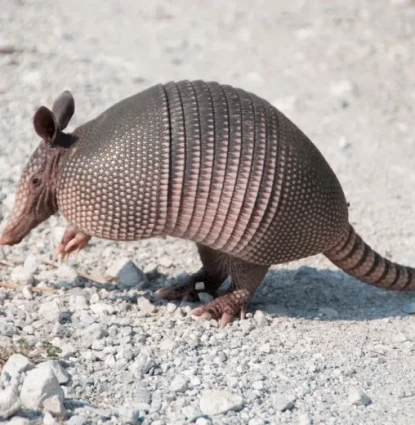
Armadillos
The Nine-Banded Armadillo (Dasypus novemcinctus) is the only armadillo species in Florida and one of the most common nuisance species statewide. Armadillos dig characteristic foraging holes and burrows up to 15 feet long, often under foundations, AC pads, and pool decks — structural damage is the primary concern. According to the CDC, some armadillos in the southern United States naturally carry Mycobacterium leprae, the bacterium behind Hansen's disease (leprosy). The agency is clear that catching it from an armadillo is possible but unlikely, and that most people who come into contact with them never get sick. It is not purely theoretical in this part of the state: CDC's Emerging Infectious Diseases journal published a 2023 case report of locally acquired leprosy in Central Florida in a patient with no relevant travel history. Wear gloves, keep pets away from open burrows, and do not handle one bare-handed. Florida law allows year-round trapping and removal of armadillos on private property, but under FWC rule 68A-9.010 a live-captured animal must be released on the property it was caught on, released off site only where the receiving land is in the same county, runs to at least 40 contiguous acres and its owner has given written permission, or euthanized humanely. Whichever it is, the rule gives 24 hours from the capture or the trap check. Driving it to a park or a patch of woods is not one of the options. Professional removal combines live-trapping along the active foraging path, habitat modification (irrigation reduction, grub control), and exclusion fencing where structural damage risk is high.
Armadillos leave distinctive signs of their presence: holes scattered across your yard. Large, basketball-sized holes serve as shelters, while smaller, golf ball to tennis ball-sized holes mark their foraging trails. These smaller holes are commonly found in mulched areas, dirt, or sand. If you're noticing these telltale signs, you likely have an armadillo problem.
At Dr. Critter, we frequently address complaints related to armadillos damaging sod, landscaping, and gardens. Our comprehensive armadillo control services include an inspection to identify damage and burrows, humane trapping and removal of the animals, surface filling and capping of burrows, and cleanup of biological attractants. Don't let armadillos disrupt your property. Contact Dr. Critter for expert armadillo removal and control.
What does Dr. Critter actually do about an armadillo?
The visit starts on the ground rather than at the lawn. A technician walks the slab line, the pool deck, the AC pad, the shed skirt and the fence line looking for burrow entrances, because one animal usually maintains several and the working entrance is rarely the obvious one. On sandy ridge soil the first job is establishing whose hole it is: a gopher tortoise burrow is protected in Florida and may not be disturbed without an FWC permit, so that gets ruled out before anything is touched. Traps then go on the runway between the burrow and the feeding ground rather than over the holes, which is the difference between catching the animal in days and never catching it at all. The inspection and the phone estimate are both free, and the quote comes after the walk rather than off a price list, because the two things that move the number are how many burrows are under structure and how much trenching the property needs.
What does the yard and structure repair cover?
Removal is half the job and it is the half that does not last on its own. Once the animal is out and the burrows are confirmed empty, they are collapsed and backfilled, which is the part that matters when one of them runs under a slab: the excavation removes the fill the concrete bears on, and that is what cracks a pool deck. Exclusion trenching then goes in where a structure is at risk, buried and turned outward at the base so the next animal cannot simply dig under it. Surface rooting damage across the turf recovers on its own once the animal is gone; the structural work does not, and it is the reason armadillo jobs are quoted as repair work rather than as trapping.
What does armadillo damage look like in a Central Florida yard?
Two signatures, and they appear together. Shallow cone-shaped holes across the lawn, roughly three to five inches wide and just as deep, where the animal has nosed out grubs and worms. And a burrow entrance seven to ten inches across, usually tucked against something solid, whether that is a foundation wall, an AC pad, a pool deck, or a shed footing. The burrow is the expensive half. Squirrels, skunks, raccoons and moles dig in Florida lawns too, and our guide to telling armadillo holes apart from other digging walks through each one.
Why do armadillos dig under slabs and pool decks?
Because the edge of a slab gives them a stable roof to tunnel under. Burrows can run fifteen feet and branch, and in sandy Central Florida soil that removes support from beneath concrete. Cracked pool decks, settled AC pads, and undermined walkways all trace back to the same cause, which is why armadillo work is treated as a structural problem rather than a lawn problem.
| Season | What the animal is doing | Typical yard sign |
|---|---|---|
| Mar–May | Young emerging from spring burrows | Several animals working one property |
| Jun–Sep | Peak digging, as the wet season drives grubs near the surface | Nightly new holes, fast lawn damage |
| Oct–Nov | Foraging continues; burrows deepened | Soil spoil piles at burrow mouths |
| Dec–Feb | Cool nights shift activity later and reduce it | Fewer holes, burrows still occupied |
When can armadillos be trapped in Florida?
Year round, with no closed season, and what the rules actually govern is disposition rather than timing. Our article on armadillo trapping law and yard damage in Central Florida sets out FWC rule 68A-9.010 and what may lawfully be done with a live-captured animal; there is no point restating it here in shorter form.
When is armadillo digging worst in Central Florida?
Digging tracks the soil, not the calendar, which is why armadillos are the one nuisance species here with no quiet season. An armadillo roots for grubs and invertebrates a few inches down, and it works wherever the ground is soft enough to open easily. That makes the summer wet season the heaviest stretch, and it makes the two or three nights after any hard rain worse than the fortnight before it, at any time of year. Irrigated lawns and freshly mulched beds get hit in dry spells for the same reason: they are the softest ground on the property. There is no closed season to wait out either, because the FWC classifies the nine-banded armadillo as non-native and non-protected, so a nuisance animal can be removed in any month.
Why does armadillo exclusion fail if the burrow is left alone?
Because fencing the yard and ignoring the hole treats the route instead of the residence. An armadillo burrow is a substantial structure, and one animal usually maintains several across a property, with the working entrance often tucked under a slab, a pool deck, an AC pad, or a shed skirt where it is easy to miss from standing height. Screen the perimeter without dealing with those and you have either sealed an animal inside the burrow under your patio, or left an unoccupied burrow that the next armadillo moves straight into, since the excavation work is already done for it. A burrow under a slab is also the part that turns a lawn complaint into a structural one: it undermines the fill the slab bears on, and that is what cracks a pool deck. So the sequence is remove the animal first, confirm the burrows are empty, collapse and backfill them, and only then run the exclusion barrier, buried and turned outward at the base so the next animal cannot simply dig under it.
Do Florida armadillos carry leprosy?
Some do, which is the practical reason trapping and disposal are not a do-it-yourself job: the risk comes from handling the animal or its carcass rather than from holes in the lawn. The biology, the documented case history and the sources behind it are covered in our armadillo article.
How long does armadillo removal take?
Usually one to two weeks. Traps go in along the active runway between the burrow and the feeding area rather than over the holes, which is the difference between catching the animal in days and never catching it. After removal, the burrow is collapsed and backfilled, and exclusion trenching goes in where a structure is at risk.
If the property is inside the metro, our page for armadillo removal in Orlando covers local response times and the soil conditions that make burrowing worse there.
Sources: the trapping and release rules come from Florida Administrative Code rule 68A-9.010, which the FWC enforces. The gopher tortoise check comes from the FWC’s gopher tortoise page, which says the tortoise and its burrow are both protected under state law. You may quote or reuse this page with credit to Dr. Critter and a link to https://drcritter.com/animal/armadillos/.
Quoting a figure? Cite this page ShowHide
Dr. Critter Wildlife Control. “Armadillo Removal and Control in Florida.” Last updated July 28, 2026. https://drcritter.com/animal/armadillos/
Link: <a href="https://drcritter.com/animal/armadillos/">Armadillo Removal and Control in Florida</a>, Dr. Critter Wildlife Control
Dr. Critter has worked as a nuisance wildlife control operator in Central Florida since 1996 and is listed with the Florida Fish and Wildlife Conservation Commission operator directory. Worth knowing, because most of this industry says otherwise: the FWC does not issue a trapper license, and no state license is required to remove nuisance wildlife from your home. What actually governs the work is rule, not paperwork. FWC rule 68A-9.010 decides what happens to an animal once it is caught alive: release on the property where it was trapped, release somewhere else only when that land is in the same county, is 40 contiguous acres or more, and its owner has put the permission in writing, or humane euthanasia. Dropping it off anywhere short of that is not on the list, whatever the operator tells you, and that rule binds every operator in Florida whether or not they are on any directory.