October 20, 2026
Florida Bat Removal Laws: What Homeowners Must Know Before Calling Anyone
Reviewed by Steve DeMoor (“Dr. Critter”), Florida wildlife control professional since 1996.
If you’ve found bats in your attic and started searching for help, the first thing to know is that Florida’s bat removal laws are stricter than most homeowners expect — and the wrong company can get you a fine, a stalled job, or a colony of dead pups in your walls. This guide is the same legal and procedural overview I walk through with every new bat client.
Is it legal to remove bats in Florida?
Yes, with restrictions. Florida bats are a protected nongame species under Florida Administrative Code 68A-9.010. Homeowners and wildlife control companies are allowed to exclude bats from a structure, but trapping or killing them is prohibited, and exclusion is illegal during the maternity season (see below). The Florida Fish and Wildlife Conservation Commission (FWC) is the enforcing authority. FWC bat conservation guidelines covers the official rules.
In practical terms: you can hire a wildlife control company for bat exclusion service in Orlando and the surrounding area to humanely exclude the colony using one-way devices, and you can have the resulting guano remediated. You cannot poison bats, you cannot seal them in, and you cannot do anything that traps adults away from their pups.
Florida’s Bat Maternity Season: April 16 – August 14
If you only want to know whether today falls inside that range, our bat maternity season date checker reads the date and answers it outright, along with how many days remain until the window opens or closes.
This is the most important date range in Florida bat law. From April 16 through August 14, exclusion of bats from any roost is prohibited. During this window, flightless pups are present in the colony; adults leave each night to feed and return to nurse. An exclusion installed during maternity season locks adults out and leaves the pups inside to starve.
The legal exclusion window is roughly mid-August through mid-April. If you discover bats in May or June, the legal options are: monitor the colony, document the entry points, plan the exclusion for late August, and address any health risk in the meantime (sealing off interior access to the attic, for example). A reputable company will tell you this even if it costs them the immediate job.
Florida bat removal law — the short version: Florida Administrative Code 68A-9.010 prohibits the exclusion or removal of bats from April 16 through August 14, the maternity season when flightless pups depend on the adult colony. The legal exclusion window is mid-August through mid-April. The only legal removal method is a one-way exclusion device installed at every entry point of 3/8 inch or larger; this lets adult bats fly out at dusk but prevents re-entry, and devices must stay in place 5-7 nights to ensure the entire colony has exited before permanent sealing. Trapping, poisoning, and sealing entries during maternity season are all illegal. The Florida bonneted bat is federally endangered; the Brazilian Free-Tailed Bat and Evening Bat are state-protected. The Florida Fish and Wildlife Conservation Commission enforces these rules, and violations can carry meaningful fines.
Which Bat Species Are Protected in Florida?
All native Florida bats are protected, but the level of protection varies by species. The three species most relevant to Central Florida attics:
- Florida bonneted bat (Eumops floridanus): Federally endangered under the U.S. Endangered Species Act. Rare in attics but possible in southwest Florida. Any contact with this species requires FWC and U.S. Fish & Wildlife Service involvement.
- Brazilian Free-Tailed Bat (Tadarida brasiliensis): By far the most common attic species in Central Florida. Protected as a native nongame species; subject to the maternity-season ban.
- Evening Bat (Nycticeius humeralis): Second most common Central Florida attic species. Protected as a native nongame species.
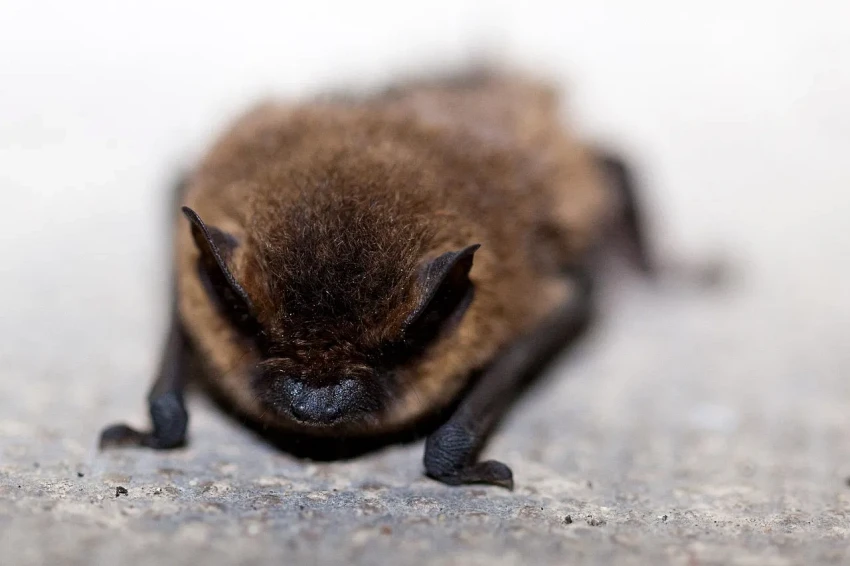
- Little Brown Bat (Myotis lucifugus): Less common in Florida than in cooler states. Populations have been reduced by white-nose syndrome elsewhere on the East Coast, so finds in Florida are increasingly notable.
Bat species identification matters because it tells you the colony size (Free-Tailed colonies can run into hundreds; Evening Bat colonies usually under 50) and because if you happen to have a Florida bonneted bat, the legal process changes. A good company will identify the species during the evening emergence count before any work is scheduled. We cover identification in more depth in our field guide to Central Florida bat identification.
What Is Bat Exclusion and How Does It Work?
Bat exclusion is the only legal removal method in Florida. It is not trapping and it is not extermination. The technique works like this:
- Evening emergence count: A technician sits outside at dusk to count bats exiting the roost. This confirms the species and colony size and identifies every active entry point.
- Entry point identification: Bats can squeeze through any gap larger than 3/8 of an inch — roughly the width of a pencil. The most common Central Florida entry points are soffit gaps, ridge vents, gable louvers, dormer flashing, and chimney junctions.
- One-way exclusion device installation: A vented funnel or netted sleeve is installed over each active entry. The geometry lets bats drop down and fly out at dusk; it does not let them crawl back in.
- 5-7 night exclusion window: Devices stay in place long enough for every animal — including stragglers and sub-adults — to leave the roost. Removing them too early is the single most common reason DIY exclusions fail.
- Permanent sealing: Once the colony has fully exited and a final emergence count confirms zero activity for two consecutive nights, the devices come off and every entry point is sealed with copper mesh, polyurethane foam, and matched flashing.
The sequence is the same everywhere we work, but the roof decides how long it takes. Most bat exclusion work in Winter Haven and across Polk County involves barrel tile and gable louvers, so there are more entry points to sleeve than a newer subdivision needs.
What Happens After Bats Are Removed?
Removing the colony is only half the job. Bat guano accumulates in roosts for years and carries Histoplasma capsulatum, the fungus that causes histoplasmosis — a lung infection that ranges from flu-like in healthy adults to life-threatening in immunocompromised people. The fungus becomes airborne when dried guano is disturbed.
Proper post-exclusion remediation involves: For a step-by-step walkthrough of what professional remediation looks like in a Florida attic, see bat infestation cleanup and attic restoration. HEPA-filtered respirators and Tyvek suits, an EPA-registered antimicrobial misted on the deposit to suppress airborne spores, HEPA-vacuum and bagged guano removal, replacement of contaminated insulation, and antimicrobial fogging before reinsulating. For any deposit larger than a small flashlight beam, this is not a DIY job — a simple dust mask does not stop Histoplasma spores. The CDC publishes a histoplasmosis fact sheet with the medical detail.
This is also when entry points get permanently sealed and the attic is restored to its original R-value with replacement insulation. We go through the full restoration scope on the attic restoration page.
DIY Bat Removal: Why It’s Illegal and Ineffective in Florida
Most DIY methods either violate FAC 68A-9.010, fail outright, or both:
- Mothballs and ultrasonic devices: Do not work. There is no peer-reviewed evidence that either deters established bat colonies.
- Sealing entry points before exclusion: Traps the colony inside. The animals die, the structure smells for months, and you have just committed an animal cruelty violation under state law.
- Trapping: Florida's native bats are protected, and under FAC 68A-4.001 and 68A-9.010 they may not be taken at all, by a homeowner or by any company. Bats are never trapped; exclusion is the only lawful method.
- Maternity-season exclusion: Whether you do it yourself or hire someone who agrees to, this is illegal and dooms the pups. Reputable Florida companies will refuse the job during this window.
The job is also genuinely dangerous: between rabies risk (rare but real in Florida bats) and histoplasmosis from disturbed guano, the PPE and procedures are not DIY-friendly.
How to Choose a Florida Bat Removal Company
Before you sign anything, verify the company can answer these questions clearly:
- Are you listed in FWC's nuisance wildlife control operator directory? The listing is voluntary and it is not a license, because FWC does not license nuisance wildlife trappers. What binds the work is FAC 68A-4.001 and 68A-9.010, so ask how the company follows them on bats.
- Will you do an evening emergence count before quoting the job? Anyone quoting bat exclusion without a dusk count has not yet identified the species or the colony entry points. The quote is a guess.
- How long do exclusion devices stay in place? Correct answer: 5-7 nights, sometimes longer. If they say one or two nights, walk away.
- What is your maternity-season policy? The right answer is “we do not exclude between April 16 and August 14 except in narrow medically necessary cases under FWC consultation.” If they offer to do it anyway, walk away faster.
- Do you handle guano remediation and insulation replacement? If not, you will need a second contractor �� and the company should be telling you that up front.
- Are you bonded and insured? Wildlife work involves attic access, roof work, and electrical proximity. Insurance is non-negotiable.
Dr. Critter’s Bat Exclusion Process in Central Florida
We have been doing bat work in Central Florida since 1996. Our process matches the legal procedure above, with one local detail: we schedule the evening emergence count in advance and time the exclusion start to land in the legal window. If you’re calling us in May, we’ll come out for the inspection now, give you a written scope, document the entry points with photos, and put the work on the calendar for the second half of August. The exclusion itself, step by step, is in how bats are removed from an attic.
Service areas with active bat work currently underway or scheduled include:
- Bat Exclusion in Casselberry, FL
- Bat Exclusion in Lake Mary, FL
- Bat Exclusion in Daytona Beach, FL
- Bat removal in Central Florida
- Dead animal removal and guano connection
- All Central Florida service areas
To schedule a free bat inspection, request a quote or call 800-932-7287. We will identify the species, map the active entries, and put together a legal exclusion plan timed for the open window.
Photo by PublicDomainPictures on Pixabay
Florida Nuisance Wildlife Laws by…


Does Homeowners Insurance Cover…
October 13, 2026
Armadillo Holes in Your Florida…
October 6, 2026


Who to Call for Wildlife in…
September 22, 2026
Florida Rabies Cases by County and…
September 15, 2026


Wildlife Removal Cost in Central…
September 15, 2026
Florida Nuisance Wildlife Trapping…
August 18, 2026


Wildlife Removal vs Pest Control:…
August 11, 2026
Central Florida Wildlife Activity…
August 11, 2026


Rats in Your Attic Could Be More…
August 5, 2026