
Click here for a free estimate to remove Squirrels!
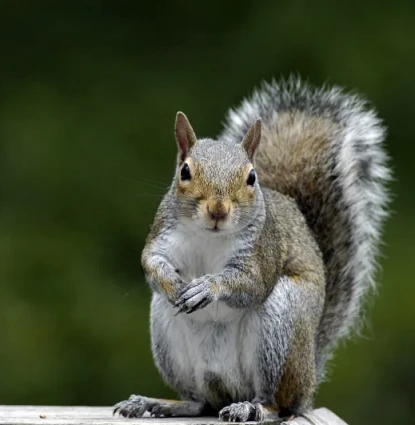
Squirrel Removal in Central Florida
Squirrel removal in Central Florida is mostly a roofline job: find the hole, let the squirrels out through a one-way device, check for young, and seal the house so they cannot chew back in. This page covers how it works, what the law allows and what it costs.
The Eastern Gray Squirrel is the primary attic-entering species across Central Florida. Adults breed twice yearly (late winter and mid-summer), so attic activity peaks in February-March and July-August when litters are present. Squirrels can chew through standard fascia, wooden soffits, and roof edge flashing; they enter through gaps as small as 1.5 inches. Their incisors grow continuously, which is why they gnaw electrical wiring, and chewed wiring in an attic is a fire risk. Florida law allows squirrel removal, and FWC rule 68A-9.010 decides what happens to a live-captured squirrel: release on the property, release elsewhere in the same county only on at least 40 contiguous acres with the landowner’s written permission, or humane euthanasia, within 24 hours. Dr. Critter's squirrel-removal protocol locates and removes any nesting kits, installs one-way exclusion devices for adults, repairs chewed wiring or insulation, and seals all entry points with copper mesh and matched flashing.
While rats are typically nocturnal, squirrels are most active during the day, particularly at sunrise and sunset. Like rats, they leave droppings and damage insulation by tunneling through it. Diagnosing a squirrel problem can be challenging, as they don't always leave droppings inside the home. Squirrels are commonly found in attics and upper floors, accessing these areas through small roofing holes.
Although squirrels may appear harmless outdoors, they can cause significant damage once inside your home. The constant chewing and chattering can be disruptive, and the financial impact of damaged fascia boards, trim, pipes, and electrical systems can be substantial. If you suspect a squirrel problem, don't delay. Contact Dr. Critter immediately to prevent further damage to your home.
What do squirrels do to a Central Florida attic?
They chew. A squirrel’s front teeth never stop growing, so it gnaws whatever it can reach: wire sheathing, the paper face on insulation, roof-edge flashing, soft wood at the fascia. Chewed wiring in an attic is a fire risk, and that alone is the reason not to let a squirrel problem run. They also pull insulation into a nest, usually close to the entry hole, and leave droppings and urine through it, so the attic needs cleaning once they are out.
Is it squirrels or rats in the attic?
Go by the clock. Squirrels are active in daylight, so the running and scratching happens during the day and the attic goes quiet after dark. Roof rats work the other shift, busiest in the first hours after sunset and again before dawn. You can often watch a squirrel use its hole from the yard; a rat you will rarely see. If the noise starts after dark, our roof rat page is the one to read, and the attic noise guide goes through every species sound by sound.
Which squirrels live in Central Florida?
Almost every attic call here is the eastern gray squirrel, the small gray tree squirrel of oak-shaded neighborhoods. The other one is the fox squirrel. FWC’s profile of the southern fox squirrel describes a much bigger animal, up to 27.6 inches long, found through the Florida peninsula in open, fire-maintained longleaf pine, turkey oak, sandhill and flatwoods. It was removed as a Species of Special Concern in 2018 but stays in FWC’s Imperiled Species Management Plan, and FWC says its conservation measures and permitting guidelines still apply. So the species gets confirmed before anything is trapped.
What does Florida law say about squirrel removal?
A nuisance squirrel can be taken out of your home, and the rule that matters most is what happens to it afterward. Under FWC rule 68A-9.010, as summarized in FWC’s nuisance wildlife FAQ, a live-captured animal has to be released on the property where it was caught, released somewhere else only if that land is in the same county, runs to at least 40 contiguous acres and its owner has given written permission, or euthanized humanely, within 24 hours of capture or trap inspection. Driving it to a park across town is not one of the options. We also do not use poison, because a squirrel that dies in the attic leaves you with the smell and the same open hole.
How does squirrel removal and exclusion work?
It starts with an inspection that finds the active hole and every other weak spot on the roofline, and checks for a nest. Limbs that touch the roof get trimmed back, because sealing a house while a branch still reaches the fascia just sends the squirrel to the next soft spot. The other gaps are sealed, a one-way exclusion device goes over the hole the squirrels are using so the adults let themselves out, and any young are found and removed by hand. Once the attic is quiet the last opening is closed with material matched to the roof, and chewed wiring and soiled insulation are dealt with. Removal usually takes three to ten days.
When do squirrels have babies in the attic?
Gray squirrels breed twice a year here, in late winter and again in midsummer, so attic activity peaks in February and March and again in July and August. FWC describes the same two breeding seasons for the fox squirrel. A nest of young changes the job. Seal the last opening while babies are inside and either the mother chews a new hole to reach them or the young die in the attic, and you find out from the smell. That is why the inspection looks for a nest before the final opening is closed.
Does insurance cover squirrel damage?
Often not. Many standard Florida policies exclude loss caused by rodents, vermin and damage that builds up over time, and a squirrel is a rodent. A sudden, specific loss can be treated differently, and your own policy wording decides it. Our guide to homeowners insurance and wildlife damage in Florida explains the usual exclusions and what to document. We photograph the damage and itemize the scope, so you have something real to hand an adjuster.
How much does squirrel removal cost?
We do not publish a price list, because the price depends on the roof: how many openings there are, how much trimming and sealing it needs, and how much insulation has to come out. The phone estimate and the inspection are both free, and the quote follows the inspection. Our guide to how wildlife removal is priced in Central Florida breaks down each stage.
How do you keep squirrels out for good?
Keep the limbs cut back from the roof and keep the sealed points sealed. Squirrels test a roofline all the time, and a patch made with the wrong material just gets chewed through. Ours are matched to the roof type and carry a lifetime warranty, so if a sealed point fails we come back at no charge.
For local detail, see squirrel removal in Orange County, Lake County, Polk County and Volusia County.
Dr. Critter has worked as a nuisance wildlife control operator in Central Florida since 1996 and is listed with the Florida Fish and Wildlife Conservation Commission operator directory. Worth knowing, because most of this industry says otherwise: the FWC does not issue a trapper license, and no state license is required to remove nuisance wildlife from your home. What actually governs the work is rule, not paperwork. FWC rule 68A-9.010 decides what happens to an animal once it is caught alive: release on the property where it was trapped, release somewhere else only when that land is in the same county, is 40 contiguous acres or more, and its owner has put the permission in writing, or humane euthanasia. Dropping it off anywhere short of that is not on the list, whatever the operator tells you, and that rule binds every operator in Florida whether or not they are on any directory.
Squirrel Control Service Areas
Dr. Critter handles squirrel control across Central Florida. If squirrels are showing up at your property, pick your city for local response details:
For a full overview of how we handle squirrels, see our main humane wildlife removal service page, or browse every Dr. Critter service area.
Related Wildlife Services
Depending on what the squirrels situation involves, one of these specialized services may apply:
- Humane critter removal — trapping and relocation of live animals.
- Animal & wildlife proofing — structural exclusion to prevent re-entry.
- Attic restoration — insulation removal, sanitization, and reinsulation after wildlife contamination.
- Dead animal removal — locating and removing carcasses with odor and pathogen remediation.
- Critter waste cleaning — HEPA-vacuum and enzyme treatment of contaminated areas.
- Emergency wildlife removal — same-day response for aggressive, venomous, or trapped wildlife.
- Rodent removal — rat, mouse, and squirrel exclusion programs.
- Snake control — the Snake Shield program for snake-prone properties.


