Click here for a free estimate to remove Opossums!
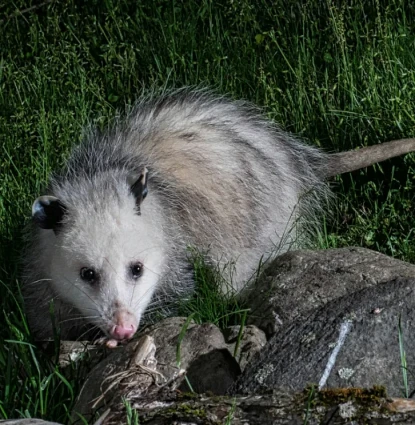
Opossums
Opossums share similarities with raccoons, leaving damage at exterior entry points and producing droppings of comparable size. While they occasionally inhabit attics and tree hollows, opossums are more often found nesting in crawlspaces, terrestrial burrows, and other dark, secluded, low-lying areas.
Dr. Critter frequently addresses concerns about opossums in trash cans, crawlspaces, attics, and yards, where they forage for insects. Our technicians are skilled in opossum removal, trapping, control, proofing, and damage restoration. We provide comprehensive solutions, including inspections, humane trapping and removal, exclusion of entry points, removal of fecal matter and damaged insulation, and cleanup of biological attractants. If opossums are causing problems on your property, contact Dr. Critter for expert removal and control services.
What does an opossum do in an attic or under a deck?
Less than a raccoon, but it is messier. An opossum rarely creates its own entry. It takes over a hole a raccoon or a rat already opened, or moves under a deck, shed, or mobile-home skirting. Indoors it does not build a tidy nest. It leaves droppings and food debris scattered across the insulation, and the smell arrives before the noise does.
What does an opossum sound like overhead?
Heavy, slow, and dragging. Closer to a raccoon than a rodent, but quieter and clumsier, with a scraping quality as the tail and body pull across the ceiling joists. Activity is almost entirely after dark. Unlike a raccoon there is no chittering, so persistent night-time dragging with no vocal calls points at opossum.
| Season | What the animal is doing | Typical sign |
|---|---|---|
| Jan–Mar | First breeding period; females denning | New occupancy of an existing hole |
| Apr–Jul | Second litter; young riding and then denning with the female | Several animals, scattered droppings, odor |
| Aug–Oct | Young dispersing to their own den sites | Under-deck and skirting activity |
| Nov–Dec | Sheltering in the warmest available space | Attic and crawlspace calls rise |
Are opossums dangerous or aggressive?
Rarely. The hissing, drooling, open-mouth display is a bluff, and playing dead is the fallback. Their body temperature is low enough that rabies in opossums is uncommon compared with raccoons. The real problems are what comes with them: fleas and ticks in the den material, and droppings and food waste that contaminate insulation.
What does Florida law require for opossum removal?
Opossums are nuisance wildlife and can be removed year round. FWC rule 68A-9.010 sets what happens next: a live-captured animal must be released on the property, released off site only where the receiving land is in the same county, runs to at least 40 contiguous acres and its owner has given written permission, or euthanized humanely, and within 24 hours of the capture or the trap check. Dropping it in a park or a patch of woods across town is not one of the options, which is why entry-point sealing matters more than the trap does.
How long does opossum removal take?
Typically three days to two weeks. Opossums enter traps more readily than raccoons, so removal is often quick. The work that follows takes longer: finding and sealing the opening that let it in, then clearing contaminated insulation and treating for the fleas the animal left behind.
Dr. Critter has worked as a nuisance wildlife control operator in Central Florida since 1996 and is listed with the Florida Fish and Wildlife Conservation Commission operator directory. Worth knowing, because most of this industry says otherwise: the FWC does not issue a trapper license, and no state license is required to remove nuisance wildlife from your home. What actually governs the work is rule, not paperwork. FWC rule 68A-9.010 decides what happens to an animal once it is caught alive: release on the property where it was trapped, release somewhere else only when that land is in the same county, is 40 contiguous acres or more, and its owner has put the permission in writing, or humane euthanasia. Dropping it off anywhere short of that is not on the list, whatever the operator tells you, and that rule binds every operator in Florida whether or not they are on any directory.